July 18th, 2026
A lighter week than usual on the new-feature front: I'm writing this from a holiday in Italy, so the focus was polish and refinements (with the race catalog as a nice bonus).
The one new feature this week: a growing catalog of real-world races. Browse well-known gran fondos, marathons and sportives across Europe, Asia, the Americas and Oceania, each with distance, course details, its full date (including the year, since some are next season) and an "Event site" link to the official page. Tap any race to open a clean details page, then add it to your calendar and make it your goal in a single step, picking your own A/B/C priority so it fits your season.
You can also share your own race so other athletes can find it, now with a link to the official event website. Shared races are reviewed before they appear. Races cover more sports too: alongside ride, run, trail run and swim, you can now set a walk, hike or strength event as an A/B/C race, and add a Notes field for course profile, start time or logistics.
Reporting an injury in your morning check-in now actually changes your training. A serious injury report drops all intensity from your day, and marking yourself "injured" logs an injury day on your Intervals.icu calendar, rests you, and starts a gradual return-to-training ramp scaled to how long the injury actually lasts. Consecutive days of "injured" now count up correctly as one ongoing injury (day 2, day 3) instead of resetting to day 1 each morning, and the injury shows once on your dashboard rather than as three separate warning cards.
Submitting your check-in now re-evaluates your day immediately: any answer that changes your readiness picture triggers a fresh look at today's workout the moment you submit. Your soreness, fatigue, stress and free-text note also reach the coach directly now, taking the worst of your check-in and Intervals.icu rather than quietly disappearing if a background sync hiccupped.
Workout steps now show your actual pace and watts next to the percentages. A step that read "75-79% Pace" now reads "75-79% Pace Β· 7:24-7:02/km" (or min/mi on imperial units), and cycling steps show the watts a %FTP target resolves to. These absolute targets are now visible on the web event page and in TrainNow's proposed workout, not only when hovering the structure chart.
A round of refinements keeps your plan honest about what your body can absorb. Taper and race weeks are now capped at your maintenance load on every plan, pre-race days become a short 75-minute priming session, and the day after a race always materializes as a genuine easy recovery workout. When your daily training budget is tight, quality sessions are now trimmed (never more than 25% below your planned time) instead of downgraded to an easy ride, and downgraded easy days rotate through endurance variations so light weeks stay varied. Multi-sport athletes keep at least one easy weekly session of a secondary sport they train regularly, and planned durations now land on their intended training load instead of overshooting by up to 50%.
Coach+ can now build rides up to 10 hours for long brevet prep, gives custom workouts a proper descriptive name, respects the indoor flag on your sessions, and reports weather in your unit preference throughout. It also stops asking for approval twice, and the Rebuild button shows a live countdown to your next available rebuild instead of a bare "limit reached". A new Indoor / Outdoor preference in Settings β Training tailors workouts to where you ride, and you can switch it straight from chat.
TrainNow now gives you the exact workout you tapped, and tells you clearly when a pick can't be served (for example a library workout you deleted) instead of quietly swapping in a different one. In "according to plan" mode, your scheduled session always stays on the table with recovery warnings right beside it, so the final call is yours.
The Analytics screens got a polish pass: the activity heatmap opens on your current weeks instead of six months back, statistic tiles keep equal heights with category labels that no longer break mid-word, and the Training Score breakdown legend sits below the chart. Weekly training load now reads done/target (like 75/253), a 1-day streak reads correctly, and workouts can no longer show a 0-minute duration.
A batch of smaller fixes: the Analytics tables and cards no longer stretch sideways beyond your phone screen, browsing back through calendar months now shows your completed workouts, stepped warm-ups render as one clean Warmup section, resized library workouts drop the stale duration from their name, and the dashboard ramp-rate warning now correctly reads points per week. Re-importing your training history also shows up in IntervalCoach right away instead of lagging up to a day.
Full changelog with all the details: https://www.intervalcoach.app/changelog
As always, let me know if you run into any issues or have feedback!
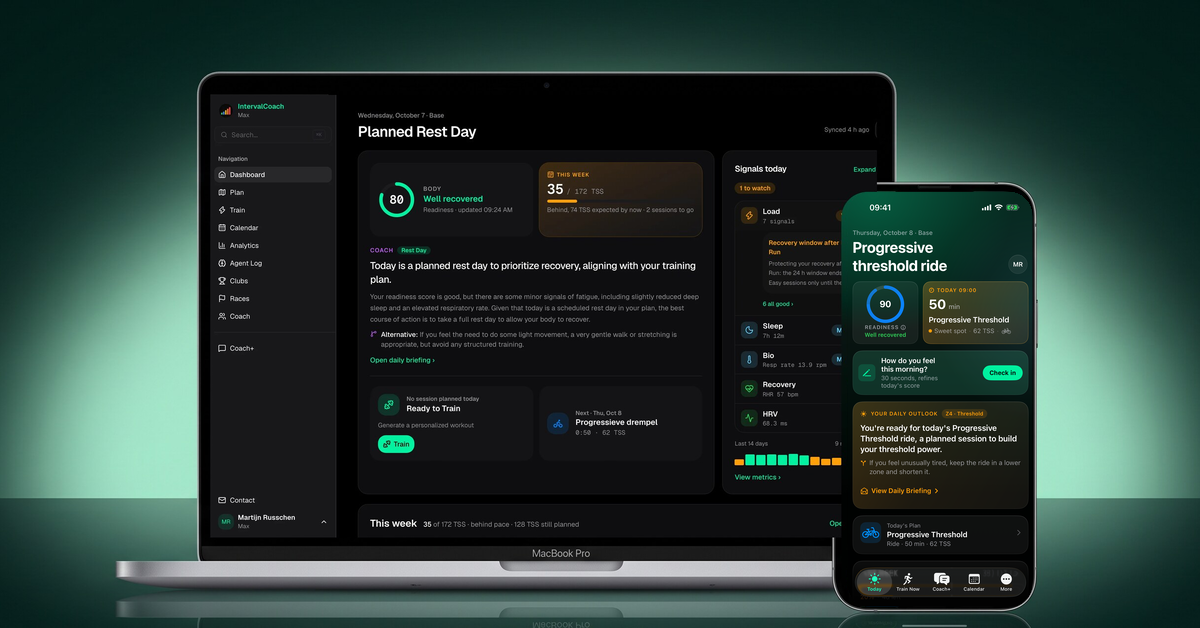
July 11th, 2026
You can now connect Google Health to bring your Fitbit, Pixel Watch, or any Wear OS device into IntervalCoach. Your sleep, HRV, resting heart rate, respiratory rate, blood oxygen, skin temperature, and VO2 Max feed straight into your daily readiness, and the workouts you record on your watch upload to Intervals.icu automatically. It's the path modern Fitbit devices use (including the new Fitbit Air), so if your recovery data lives there you get recovery-aware coaching without adding another strap. Connect it under Settings, Integrations (Pro and Max). More on the blog: Your Fitbit and Pixel Watch, Meet Your Coach.
You can now connect IntervalCoach to Claude, ChatGPT, or Cursor, so your AI assistant can read your live training data (your readiness, personal recovery curves, and adaptation signals) and use your coaching tools right inside the chat you already use. Ask it to plan your hard sessions around your calendar or draft a training summary for your coach, all from your real numbers. Available on the Max plan under Settings, Integrations. More on the blog: Bring Your Training Into Claude, ChatGPT and Cursor.
TrainNow can now build a workout around today's readiness, not just your plan: a new "Fit my plan" / "Fit my readiness" toggle means an open day can still give you a proper session matched to how recovered you are, with your recovery limits still in force. Option cards now show an estimated training load (like "β65 TSS Β· 60m"), and the status bar shows your Readiness Score. The training calendar got a big upgrade too: a goal banner with your next race, weeks remaining, and fitness trajectory; a planned-vs-actual volume bar; session RPE and workout-compliance badges; a thin intensity strip colored by Intensity Factor on every session; distance and elevation on completed rides and runs; and a "Low Z5+" alert when a race is near but you've been light on VO2max work.
Coach+ now builds real strength and home workouts (instead of quietly swapping in an easy run), can create walks, hikes, and trail runs, switches your whole week to another sport without mismatched durations or duplicate sessions, knows your body trends (VO2 Max, HR recovery, weight, menstrual phase) without being asked to look them up, and can be expanded to a wider panel on desktop. Telling the coach you're sick or unavailable now genuinely protects your plan: those days stay cleared and the next morning respects them, instead of a background sync quietly refilling them. Daily adaptation is more honest too: it names the actual signal behind a change ("your HRV is 15% below baseline"), won't add intensity the day after a hard session or when your body is signalling fatigue, and won't mistake a long easy ride for a hard one.
The Training Plan page can now show weekly hours instead of TSS, displays the coach's own proposal next to any manual override, and the calendar's week summary shows per-week fitness numbers (CTL, ATL, TSB). Tapering got real care: race week keeps you training most days with short openers instead of collapsing to a couple of sessions, taper and race weeks pick up more low-load variety (cadence drills, easy fat-max rides, swim technique), and on a polarized plan your hard days now stay genuinely hard through taper and race week. Workout quality across the board: warmups always build up and cooldowns always wind down (even after load scaling), recovery blocks no longer lock you to a cadence, HR-based easy segments sit in the right zone, fussy micro-steps merge into clean blocks, and interval sets keep every hard rep paired with its recovery. Run segments now show actual pace, and HR segments show your real bpm range.
Analytics gained a Compound Score column (watts Γ W/kg, fairer across body types) and a Variability Index / Efficiency Factor trend chart. IntervalCoach now speaks Japanese and Korean, bringing the app to 13 languages. In the iOS & Mac apps, iPad got a desktop-class experience: full-width calendar, dashboard, and sidebar, a larger Add Workout sheet covering all sports, and smoother calendar navigation, alongside more responsive quick-stat cards, another pass at eliminating app-hangs, and Mac sidebar and Settings polish.
This week's athlete spotlight: Djeno Points a Whole Spring at the Alpe d'Huez.
Plenty more under the hood: the one-click email unsubscribe link works without logging in, disabled weekly plans are no longer rebuilt overnight, imported long rides next to a race get shortened to short openers, post-workout analysis correctly classifies a session by what you actually did, and head-unit owners get better support (a power tag for IGPSport/XOSS devices, plus new toggles to turn off cadence drills and in-workout coaching messages).
Full changelog with all the details: https://www.intervalcoach.app/changelog
As always, let me know if you run into any issues or have feedback!
July 4th, 2026
Your readiness score is now a pure measure of how recovered your body is: HRV, resting heart rate, sleep, your personal recovery curve, and how you feel this morning, each compared against your own 30-day baseline. Your training plan no longer touches the number, so a rest day with a recovered body finally shows a high score. The score anchors once your morning data is in and shows when it was set, and it only moves again for a real reason: you submit your check-in, or genuinely new recovery data lands mid-day. Tap the ring to see every factor with today's value, your baseline, and whether it's working for or against you.
How you feel is now a full factor too. The morning check-in opens in its own fast pop-up straight from the readiness ring, and logging soreness, fatigue, stress, mood or motivation (there, or directly in Intervals.icu) feeds straight into your score. Training without a wearable? Your score is now built from your recovery curve, your check-in, and your accumulated training fatigue. And the 14-day wellness ribbon on the dashboard now shows your own Readiness Score history, day by day.
Your calendar now holds real, fully structured workouts for your whole planning horizon: four weeks ahead on Pro, eight weeks ahead on Max, and the current week on Free. Every session is built and synced the moment your plan exists, so workouts reach your head unit or Zwift weeks in advance. And your week now rebalances itself in real time: complete an unplanned ride and the remaining sessions ease back to keep the week within your target load; move or delete a workout and the rest of the week adjusts around it. Hard days stay spaced, and today plus everything already done are never touched. Prefer to manage your week yourself? Turn it off in Settings.
Weekly targets got smarter underneath as well. Your targets now build toward what you've shown you can handle instead of stalling at a number based only on your scheduled hours, your build phase now actually steps up week over week, and a single unusually big week no longer inflates every target after it.
Open a planned outdoor ride or run and you'll see the forecast for exactly when you'll be training: temperature and feels-like, an hour-by-hour strip from your start time, wind speed and direction, rain chance, UV and more. It shows for upcoming outdoor sessions within the next 10 days, rolling out on iPhone first with web and Android to follow. Coach+ can factor the weather into its advice too: ask whether to move a wet ride, take a session indoors, or pick the driest day to train. And you can now start that chat straight from a workout: open any planned session and tap "Ask Coach+ about this workout".
Your easy and aerobic rides now actually feel different from each other: cadence rides alternate high- and low-cadence blocks, spin-up rides add short bursts of leg speed, pickup rides drop in brief tempo touches, and long aerobic rides hold one steady effort. The same "right name, real structure" fix covers running and swimming: run VO2max sessions build the shape they're named for, anaerobic sessions match their description, and the swim sprint test is a real speed test. Adding a training to your calendar now builds the complete workout right away instead of a placeholder, and recovery spins are now tagged as recovery so Intervals.icu and Strava keep your intensity mix honest.
A big week for polish too: marking days as injured or sick now clears planned workouts from those days, accidental duplicate workouts a few weeks out are cleaned up automatically, fuelling advice now scales with the session instead of giving a 15-minute commute a race briefing, heart-rate runs keep every effort on heart rate, Coach+ can build very short sprint efforts and switch runs to power targets, planned cycling workouts show actual watts next to each %FTP target, you can remove your goal directly from Settings, hard sessions land on the days you asked for, polarized plans stay polarized, and if you pay through both Stripe and an app store your higher plan now always wins.
Three new posts this week: Your readiness score grew up on the thinking behind Readiness Score 2.0, Your whole training block, planned on the new planning horizons, and the June 2026 update rounding up last month.
Full changelog with all the details: https://www.intervalcoach.app/changelog
As always, let me know if you run into any issues or have feedback!
June 27th, 2026
The big one: IntervalCoach is live on Google Play. It's the full app, matching the iPhone version: your dashboard and readiness, the daily briefing, Coach+, training plan, calendar, and the activity charts (heart rate, power, speed, your power curve and durability). Search "IntervalCoach" on Google Play or grab it from the link on our homepage. There's a full write-up on the blog.
You can now link Claude, ChatGPT or Cursor directly to IntervalCoach, so your assistant works with your training: ask it for your readiness and recovery, your plan and performance trends, compare past activities, or have it create and adjust workouts, all from its own chat. It's a Max-plan beta. Turn it on under Settings β Beta, add IntervalCoach as a connector in your assistant, and follow the step-by-step setup guide at docs.intervalcoach.app.
If you train your rides by heart-rate zones with no power meter, the planned TSS on your calendar now matches your target, both for on-demand workouts and your weekly plan. Previously an easy ride could land well below the number you set.
A whole batch of Coach+ improvements landed this week. The coach now reads your live calendar before moving, deleting, or adjusting a session (no more "no workout found" on a day that clearly has one), confirms the change actually landed before telling you it's done, and won't move the wrong session when you name a day a workout isn't on. Deleting a workout now keeps it deleted instead of having the plan quietly refill the day. It also stays anchored to the correct date in long chats, and re-checks the latest data before explaining a number you've flagged as wrong, instead of inventing reasons.
IntervalCoach can now spot an oncoming illness a little earlier: a multi-day rise in resting heart rate paired with a drop in HRV now backs up the other early-warning signs, so the coach eases your training toward recovery sooner, even if your wearable doesn't measure temperature or breathing. Coming back is paced more carefully too: a sensible minimum easing window after any illness, lifted only once your resting heart rate returns to your own normal. There's a deep dive on the blog: can you actually see illness coming in your data?
Several plan and workout corrections shipped: polarized plans now keep your hard days genuinely hard instead of slipping into the tempo "grey zone"; your weekly TSS target is sized from all the days you train (not just your single longest day) and no longer shows a number above what your available time supports; running warm-ups now build up to the main set and cool-downs ease down from it; a new workout is no longer added onto a day you've marked as a holiday; and a session can no longer quietly disappear when your weekly plan rebuilds. Strength and gym sessions now show an estimated recovery time, and your dashboard recovery ring matches your daily email and Coach+.
The iPhone app's home screen is faster and smoother: we fixed brief freezes that could lock up the app for a few seconds when opening your dashboard.
Full changelog with all the details: https://www.intervalcoach.app/changelog
As always, let me know if you run into any issues or have feedback!
June 20th, 2026
IntervalCoach learns a recovery curve for every session type, how quickly you bounce back from VO2max, threshold, long endurance, and so on, starting from proven defaults and personalizing as your HRV, resting heart rate, and sleep data build. That curve now shapes your daily readiness, spaces your hard days, and estimates how long you'll need after a session you just finished. Pro and Max athletes get the full per-stimulus recovery-curve chart on the Analytics page, a recovery meter in the Daily Briefing showing whether today sits ahead, on track, or still behind, and a recovery snapshot in the weekly summary email. Coach+ can now answer "why can't I go hard again yet?" straight from your own curve.
Readiness is now a single 0 to 100 score, and the ring on your dashboard is drawn in segments so you can see exactly what built it: your readiness level as the foundation, then each signal that nudged it (HRV and resting heart rate, your recovery curve, recent training variety). Tap it for the full breakdown with the numbers, ask Coach+ "why is my readiness 78 today?" and it reads the real figure, and your morning email now explains your readiness, not just your CTL/ATL/TSB.
IntervalCoach now spots the early signs of an oncoming illness from your wearable: when breathing rate, blood oxygen, and skin temperature drift off baseline together, it eases the day toward recovery so you don't train through it. And if you track your menstrual cycle, your readiness now expects the natural luteal-phase dip instead of reading it as poor recovery; you can log it in the daily check-in or sync it from health data. Easing back after illness now scales to how long you were actually sick and lifts as soon as your recovery metrics are back to normal, rather than holding a flat two-week cap.
Your activity view now charts the whole session: heart rate, power, speed, cadence, and elevation over time, each with its own stats and zones, and you can drag across any chart to read the exact value. Every ride also gets a power curve (your best power for 5 seconds to an hour against your all-time best) and a new Durability view that compares your best efforts early in the ride against efforts deep into it, so you can see whether your power held or faded.
Workouts you send to your Apple Watch now carry heart-rate and cadence alert targets, so the watch nudges you to hold the right zone, and they no longer tack on an extra warmup or cooldown. Completed workouts also sync back to Intervals.icu with their power, cadence, and lap structure intact, and now sync in the background without you having to open the app. Your 0 to 100 readiness score now appears on the home and lock-screen widget, the Recent Activities list is grouped with date separators, and the app reads in your language throughout after a big translation pass. Mac users get a fixed subscription-management screen, and a performance fix clears up calendar-related hangs.
Analytics now plots TSB (Form) as its own line and labels each training phase on the projection chart, and the calendar week summary shows total distance and elevation for the week.
A workout you build in Coach+ chat no longer disappears from your calendar, taper and race weeks no longer get flagged as fitness "at risk" or nudged toward intensity, running threshold and stride sessions are built at the right shape and pace, duplicate Strava/device sessions no longer double-count your weekly load, and a glitchy resting-heart-rate reading no longer throws off your baseline.
Two new posts go deep on all of this: One system that learns how you recover, and shows its work and Tired, or getting sick? IntervalCoach now catches it before you feel it. Plus a new athlete spotlight: Marsl and the Seven-Hour Saturday.
Full changelog with all the details: https://www.intervalcoach.app/changelog
As always, let me know if you run into any issues or have feedback!
June 13th, 2026
Your coach now adapts the day as your recovery data comes in. If your overnight HRV and sleep sync late and show more fatigue than your morning plan assumed, it dials today's ride back to a lighter version of the same session instead of leaving you with a plan that no longer fits. A too-early "rest day" call can now reverse itself too: if the data that lands mid-morning shows you're actually well recovered, the rest suggestion is withdrawn and your planned session stands. (Cycling for now, for athletes on automatic or adaptation preview.)
We also made the daily briefing far more reliable for anyone training off a recovery device. Your briefing and workout now still arrive on mornings when Whoop misses its sync, built from whatever sleep and recovery data is available, instead of waiting indefinitely for numbers that never come. If your Whoop connection silently breaks, IntervalCoach now notices and emails you to reconnect. And Whoop users can finally set a fixed briefing time in Settings β Notifications, so it waits for the hour you picked instead of landing at 5am.
The Training Plan got smarter about how much it asks of you. Your available hours are now treated as a ceiling, not a target to fill: plans build from what you've actually been training and ramp up gently from there. The Training Plan page now shows the three inputs behind your weekly load (what your goal needs, your hours ceiling, and your recent training) and which one is setting your number, so you can tell whether to raise your goal, add hours, or just keep training. If you fall behind, your targets nudge back up to help you catch up instead of quietly getting easier, and polarized plans now keep their hard days genuinely hard.
Analytics picked up a new Rider Profile that reads your rider type (Sprinter, Climber, Time Trialist and so on) from the shape of your power curve, alongside your strength in each energy system at a glance. Power charts can now switch between watts and W/kg with one toggle. And outdoor rides and runs now show a map of your route right in the activity view, with redesigned shared activity pages built around it.
Coach+ stopped wasting your messages on avoidable errors: schedule changes and workout edits that used to fail on a technicality now go through the first time, deleted workouts stay deleted, and it tells you the truth about plan rebuilds instead of pointing you at an unchanged calendar. The in-app help assistant can now answer questions about your own account using live data: your plan, your training phase and this week's target, why today's session is what it is, and whether your devices are syncing.
IntervalCoach now speaks Traditional Chinese (ηΉι«δΈζ), and if your browser is set to a language we support you'll get a one-time nudge to switch everything over, including your daily emails. On Android you can now install IntervalCoach to your home screen, and pinch-zoom works again. We also published three reads this week: Coming Back From Illness Without Blowing Yourself Up, plus athlete spotlights on @javi building a Mallorca engine for La Purito and @tino-76 rebuilding at 49 on his own terms. Max subscribers can now switch down to Pro right in Settings, heart-rate cycling workouts now show their real training load, and multi-sport schedules now stick.
Full changelog with all the details: https://www.intervalcoach.app/changelog
As always, let me know if you run into any issues or have feedback!
June 6th, 2026
You can now log time off without leaving IntervalCoach. The "+ Add" menu on the calendar and training plan has Sick, Injured and Holiday alongside Workout and Race β pick a date range, say whether you're fully out or just limited, and the coach eases off or pauses training for those days, then ramps you back up gradually once you're past it. No more hopping over to Intervals.icu to block out a sick week or a holiday.
There's a new way to shape how you train, too. In Settings β Training you can pick a training methodology: Norwegian Singles turns your quality days into controlled sub-threshold work (the "golden zone" just below threshold) instead of all-out VO2max, Norwegian Doubles adds a second short sub-threshold session on your two-a-day days to build threshold volume with less strain, and the Easy Interval Method keeps everything aerobic with frequent short, moderate efforts that never go truly hard. Recovery and taper weeks stay easy whichever you choose.
Your weekly plan can also start adapting itself (beta). Turn on "Self-adjusting weekly plan" in Settings β Beta, and when you add, move, or delete a workout the week rebalances around your change β staying within about 10% of your weekly load target and keeping hard days well spaced, without ever touching today or sessions you've already done. Your own change always comes first.
On the blog, I wrote up Race Pace Plans: A Coach For The Day Itself β a goal-aware pacing strategy, a warm-up protocol, and an honest read on race morning for your A and B events, with a lighter version for C races.
Clubs had a busy week: leaderboards can now span 7 days, 30 days, 90 days or a year instead of only the trailing week, the Clubs area opens with an at-a-glance Overview tab, any member can add club events and edit the ones they created, you'll get a push when a club adds or changes an event, and you can make a club discoverable so others join without an invite code.
The coaching got sharper, too. When the coach caps your intensity for a rough recovery day, your interval targets are now actually lowered to match (VO2max and anaerobic sessions trim volume instead, to protect the hard stimulus), and running workouts honour the cap as well. Your weekly plan now leans into the workout types you prefer and away from the ones you don't, TrainNow can build a session to a target TSS, and a new "Coach picks the duration" mode treats your set time as a ceiling and finds the most effective (often shorter) session within it.
A few smaller touches and fixes round things out: there's now a Help Center and a public Roadmap in the menus, date pickers share one calendar with weeks starting Monday, and the Daily Briefing only surfaces signals that need attention. On reliability β upcoming workouts no longer get stuck as greyed-out placeholders after you edit something in Intervals.icu, the Daily Briefing no longer shows a stale card first thing in the morning, checkout and Coach+ top-ups go through cleanly again, and a distance-labelled running rep (like 8Γ500m) is no longer misread as 500 minutes.
Full changelog with all the details: https://www.intervalcoach.app/changelog
As always, let me know if you run into any issues or have feedback!
June 1st, 2026
Clubs are here β you can now train with the people you actually ride and run with. Create or join a club to share an activity feed (who joined, badges earned, completed workouts), compare on leaderboards built around effort you control β weekly TSS, consistency, and 4-week fitness growth, not raw watts β and post shared events that each member can add to their own calendar, where the coach folds them into their individual plan. Privacy is strict: you choose what you share per club, and your recovery and wellness data is never shared with clubmates. Joining is free on every tier; creating a club is part of Pro (up to 10 members) or unlimited on Max, which also gets a weekly AI digest summarizing how the group trained. More in the Introducing Clubs post.
Trail running and brick workouts both became first-class this stretch. Trail Run is now a distinct sport across TrainNow, the workout picker, the library mapper, and the race editor β with GAP-aware race pacing, separate trail/road critical-speed and pace zones, elevation-aware post-workout analysis, and five new trail workouts (Long Climb, Downhill Repeats, Power-Hike Intervals, Technical Trail Intervals, Ultra Time-on-Feet) that get picked preferentially when you have a trail goal. Bricks moved beyond on-demand: mark a day as Brick and the weekly planner now schedules a bike-to-run pair, switching to a race-simulation pattern in your Peak and Pre-Race Taper weeks, and downgrading to a single easy ride when readiness is poor. The full story is in Trail Running and Brick Workouts.
Your coach also got more personal. Pro and Max athletes can flip on a new Recovery Profile card (Settings β Beta) that fits your own recovery curves per stimulus β tempo, threshold, VO2max, anaerobic, long endurance β and the planner now uses those curves to space hard days further apart when your data says you recover slowly. Max athletes can benchmark their curves against a peer cohort. On top of that, the daily workout pick and the explanation in your email now draw on the notes the coach has accumulated about you (ranked by relevance to today's situation), and the coach quietly writes new notes after each session β so Settings β Coach Memories fills in over time. Hard cycling sessions now also open with a short pre-activation primer at the day's main-set intensity, and there's a new Billat 15/15 VO2max workout in the catalog.
A lot of plan-quality and reliability work shipped too. When your goal event is automatic and the current one passes, your plan now rebuilds toward the next goal on its own instead of leaving the weeks empty. The Sunday refresh no longer collapses a week to a single session when the plan changes shape, and a few unavailable days (an appointment, a weekend away) no longer flip the whole week into an empty "Holiday" shape and wipe your pushed sessions. The race-event form now pre-fills planned load from sport and target time, and distance/load caps were raised so ultra-distance brevets up to Paris-Brest-Paris fit with their real numbers. Plus a batch of fixes: library workouts keep their real power and zone targets on upload, threshold sessions honor the Z4 ceiling across every template, the Workout Structure chart renders correctly for runs and swims, Training Milestones unlock again (and backfill retroactively), the activity heatmap stops showing trained days as rest for returning accounts, running pace no longer reads "3:60 /km", and the daily email greeting and week overview match when and what they should.
Also new on the blog: the May 2026 update recapping the month, and two athlete spotlights β @falsesummit at Pikes Peak and @jos-stapel-beukers' rebound.
Full changelog with all the details: https://www.intervalcoach.app/changelog
As always, let me know if you run into any issues or have feedback!
May 27th, 2026
Trail running is now a distinct sport across the platform. Workouts, the library mapper, TrainNow, the workout picker, and training schedules all recognise TrailRun, and the in-app race editor accepts it as a goal event.
Pacing is elevation-aware: Critical Speed and pace zones are separated for trail and road via GAP normalisation, race plans use GAP-aware targets, and post-workout analysis carries elevation and terrain context. Trail race events are auto-detected, weekly plans support vertical-meter targets, and coaching memory now differentiates trail and road stimuli.
Walks and hikes count as training input. They contribute to weekly TSS, register as active recovery, and can be set as goal events for charity walks and multi-day hikes.
The native iOS and Android app is now available, replacing the Catalyst build with a faster, lower-overhead experience. The athlete switcher is accessible on mobile, and a Brick chip surfaces in the training schedule.
Brick is now a per-day sport toggle in the weekly plan, with automatic downgrade to a single sport when readiness is poor.
Per-stimulus half-life feeds the weekly plan as a hard-day spacing constraint, and Max-tier athletes can benchmark their recovery curves against a peer cohort.
May 27th, 2026
Brick sessions are now a first-class training stimulus. Schedule bikeβrun bricks directly from TrainNow, and let the daily cron and weekly planner build them into your block with race-simulation patterns when appropriate.
Bricks appear as a per-day sport toggle in the weekly plan, surface as a dedicated chip in the iOS training schedule, and automatically downgrade to a single sport when readiness is poor.
Trail Run is now a distinct sport across TrainNow, the workout picker, library mapper, race editor, and training schedule. Critical Speed and pace zones are split between trail and road (or GAP-normalised), race pace plans are GAP-aware, and post-workout analysis carries elevation and terrain context. Trail race goals are detected automatically, coaching memory separates trail and road stimuli, and weekly plans support vertical-meter targets and trail-specific structure.
Walks and hikes count as legitimate training input β contributing to active recovery and weekly TSS, and supported as goal events for charity walks and multi-day hikes.
Per-stimulus half-life now feeds into the weekly plan as a hard-day spacing constraint. Max-tier athletes can benchmark their recovery curves against a peer cohort.